

Table of Contents
True happiness lies in purifying the intellect and realisation of the self. In this article, we will elaborate the methods of purifying the intellect and self realisation.
Third Principle
In Chapter 18, Verse 37, the Gita distinguishes between different types of happiness, highlighting the one that is “poison at first, but nectar at the end.”
Yat tad agre viṣham iva pariṇāme ’mṛitopamam

Tat sukhaṃ sāttvikaṃ proktam ātma-buddhi-prasāda-jam
That which seems like poison at the beginning but turns into nectar in the end, and which arises from the purity of one’s own intellect and self-realisation, is said to be Sattvic (Pure) happiness.
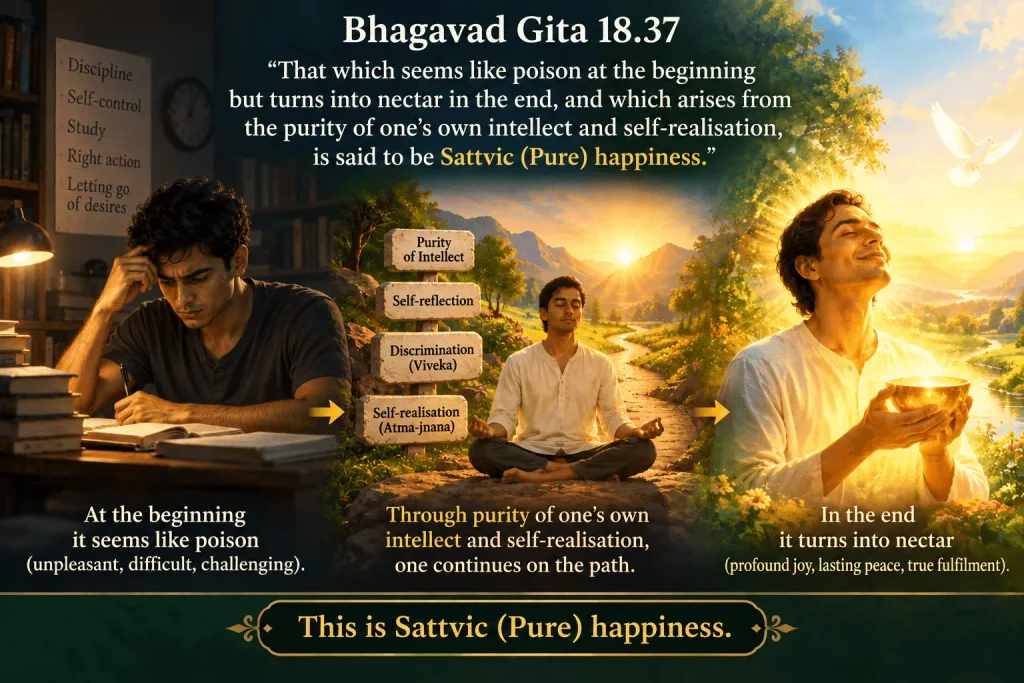
What a beautiful and practical custom happiness follows! We have all experienced this. Recall your childhood – specifically when your school days began and you started to understand concepts like discipline and routine. Initially, it all seemed so difficult! One felt somewhat restricted. We would reminisce about the days when our time was entirely our own to spend as we pleased, free from any compulsion; yet suddenly, we had to wake up early and get ready for school. We had to maintain discipline in class and study subjects we didn’t even like.
On top of that, there was the burden of classwork and homework for every single subject. There was constant pressure to complete assignments; failing to do so meant facing embarrassment in class the next day. Then came exam preparations, the pressure to perform well, and so much more. Yet, looking back at those days now brings a sense of peace. Whatever we are today is thanks to the disciplined lifestyle we led back then; the more disciplined one’s life was in those days, the more successful one has become today.
This is a shared experience in almost all our lives, conveying a powerful message: what we initially perceived as a hardship eventually transformed into our happiness and well-being.
Similarly, from a health perspective, the Neem tree holds immense significance. It is so valuable that it has even been dubbed the “village pharmacy.” In terms of taste, it is extremely bitter, yet it is incredibly beneficial for health. There are other medicinal plants – such as Giloy, Amla (Indian gooseberry), and Aloe Vera – that share this characteristic – they taste intensely bitter but act like nectar for our health.
There is a common adage in traditional wellness: “If something tastes bitter, it is usually highly beneficial for your body.” In fact, Ayurveda encompasses an entire philosophy regarding this encapsulated in the Sanskrit saying “Arogyam Bhishajam” – implying that true medicine often fails the initial test of taste. This very principle applies to our lives as well.
Conversely, pleasures derived from succumbing to vices are fleeting and short-lived; yet, people are increasingly indulging in immorality, sin, and corruption in pursuit of these transient joys. While they may seem immensely pleasurable at first, they ultimately prove detrimental not only to the individual but also disastrous for society, the nation, and the world.

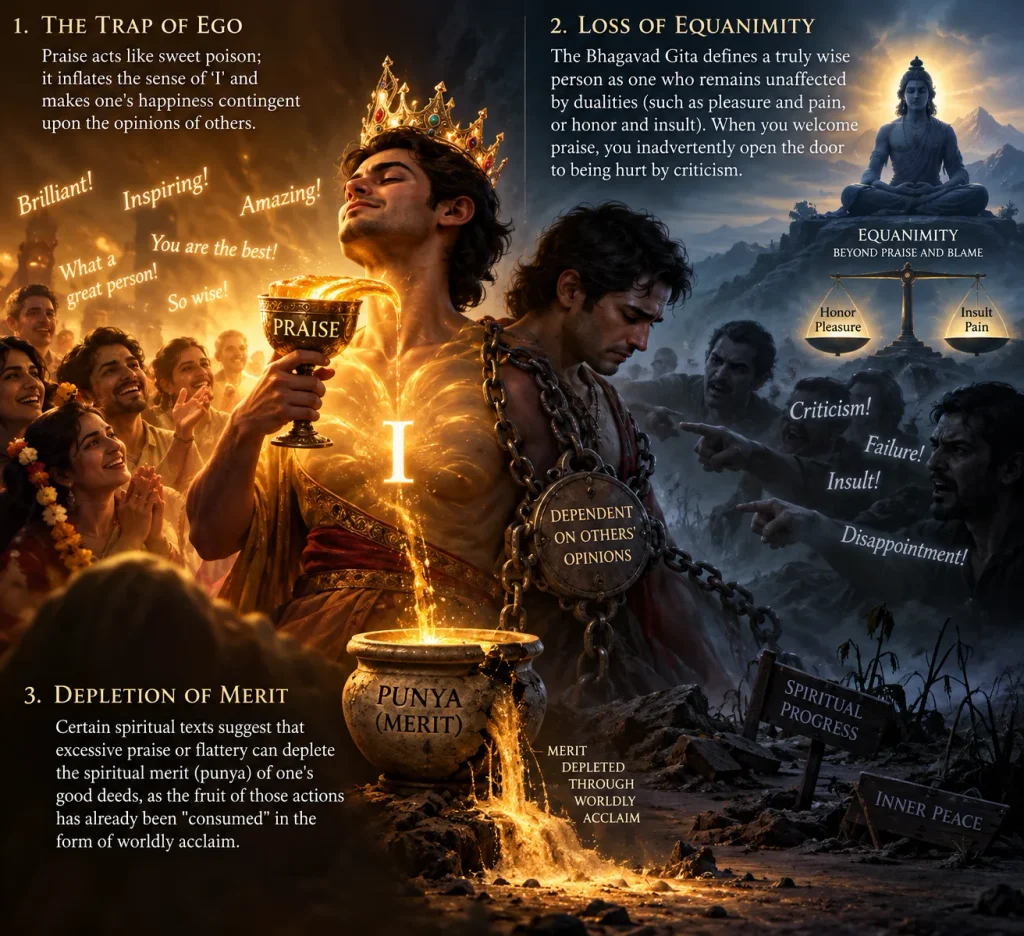
Scriptures often warn about the subtle and insidious nature of praise, as it fuels the ego and renders a person dependent on external validation.
- The Trap of Ego: Praise acts like sweet poison; it inflates the sense of ‘I’ and makes one’s happiness contingent upon the opinions of others.
- Loss of Equanimity: The Bhagavad Gita defines a truly wise or spiritual person as one who remains unaffected by dualities (such as pleasure and pain, or honor and insult). When you welcome praise, you inadvertently open the door to being hurt by criticism.
- Depletion of Merit: Certain spiritual texts suggest that excessive praise or flattery can deplete the spiritual merit (punya) of one’s good deeds, as the fruit of those actions has already been “consumed” in the form of worldly acclaim.
The Perspective on Insult (Criticism/Humiliation)
Surprisingly, from a spiritual or psychological standpoint, insults are viewed quite positively. They are rarely considered truly harmful to the soul – they are detrimental only to the ego.
The Ultimate Test of Equanimity
Chapter 12, Verse 19 of the Bhagavad Gita clearly identifies the person dearest to God as one who treats criticism and praise alike:
Tulya-nindā-stutir-maunī santuṣṭo yena kenacit

Aniketaḥ sthira-matir-bhaktimān-me priyo naraḥ
A devotee who regards praise and blame equally, remains silent (refraining from unnecessary speech and maintaining an inward focus), is content with whatever comes their way regarding the body or circumstances, holds no attachment to any specific dwelling, has an intellect steadfast in God, and is filled with devotion – such a devotee is exceedingly dear to the Lord.
An Agent of Inner Purification (Bitter Medicine)
Just as a bitter herb expels toxins from the body, an unprovoked insult acts as an agent of inner purification. It compels you to look within, shatters false pride, and tests whether your peace depends on the external world or on your own inner foundation.
Absorbing Karma
Traditional wisdom holds that when someone criticizes or insults you without cause, they often shoulder the burden of your heavy karma, while you are liberated from it; thus, paradoxically, the person causing harm becomes a stern benefactor.
In short, scriptures view praise as a sweet trap that binds you to Maya (illusion), whereas they regard insult as a bitter medicine that eradicates the ego and strengthens the soul.
Specific verses in the Bhagavad Gita directly explain how to cleanse the intellect of old thought patterns or habits and how self-realization (knowing one’s true self) is attained.
Here are the key verses and principles from the Gita that elucidate this process:
The Method of Purifying the Intellect
Chapter 2, Verse 53 describes how the intellect moves away from confusion and scattered worldly desires toward clarity and single-minded focus:
śhruti-vipratipannā te yadā sthāsyati niśhchalā

samādhāv-achalā buddhis tadā yogam avāpsyasi
“When your intellect – currently bewildered by the noise of conflicting ideas or sensory inputs – becomes unwavering and focused in deep meditation (Samadhi), you will attain self-realization (Yoga).”
Process of Purifying the Intellect: The impurities of the intellect include doubt, restlessness, and being pulled in various directions by sensory objects. Purification is achieved through Viveka (discernment between the permanent and the impermanent) and Abhyasa (constant effort to focus the mind).
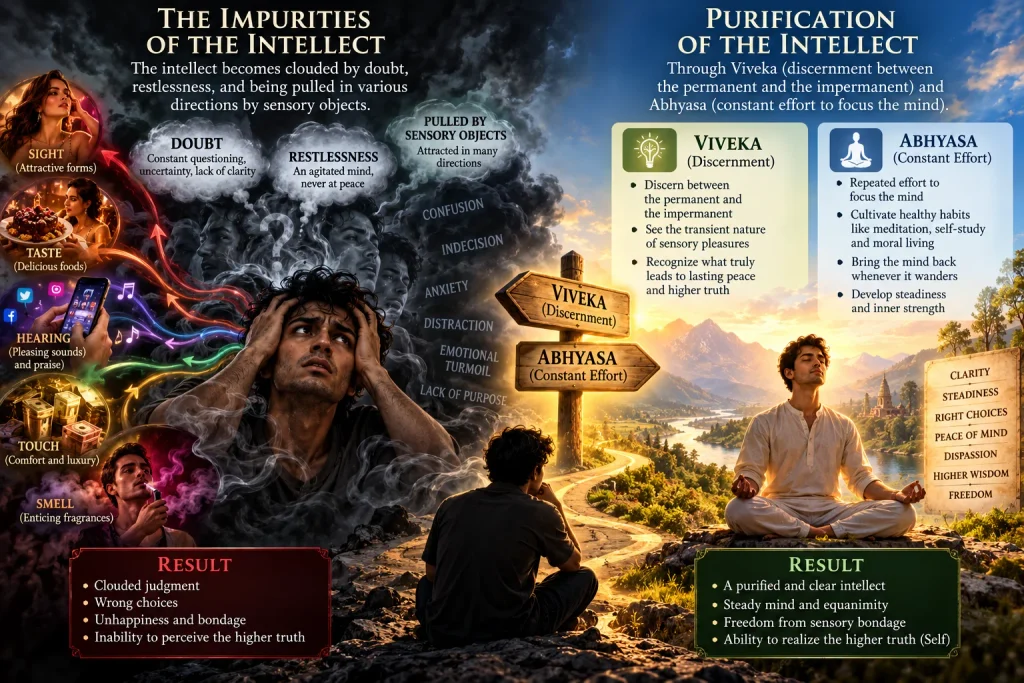
From Lower Intellect to Higher Intellect (Chapter 18, Verses 30-32): The Gita categorizes the intellect into three types. Sattvic (pure) intellect discerns right from wrong and appropriate action from that which should be feared, ultimately liberating the self from bondage. Purifying the intellect means steering it away from blind impulse (Tamasic) and restless self-interest (Rajasic) toward a state of clarity, dutifulness, and tranquility.
Driving Forces: Knowledge (Jnana), Action (Karma), and Devotion (Bhakti).
Chapter 4, Verse 38, describes the supreme purifying agent:
Na hi jnanena sadrisham pavitram iha vidyate;

Tat svayam yoga-samsiddhah kalenatmani vindati.
There is nothing in this world as purifying as knowledge. One who attains perfection in Yoga naturally discovers this within oneself over time.
Knowledge acts as a key driver for purifying the intellect. When knowledge is inculcated, intellect carries it and when it is churned then the toxins within the intellect get removed. Consequently, intellect becomes purer and sharper.
Self-Realization (Atma-Darshan): When the mirror of the intellect is cleansed of the dust of ego and dualities, the true ‘Self’ (Atman) becomes clearly visible. Chapter 6, verses 20-21 describe the moment of this interview:
yatroparamate chittaṁ niruddhaṁ yoga-sevayā

yatra chaivātmanātmānaṁ paśhyann ātmani tuṣhyati
When the mind becomes calm and finds stability through the practice of yoga, and when the person becomes satisfied in the soul itself by seeing the soul through the soul…
sukham ātyantikaṁ yat tad buddhi-grāhyam atīndriyam

vetti yatra na chaivāyaṁ sthitaśh chalati tattvataḥ
…In that state, one experiences infinite transcendental bliss, which can be understood by the pure intellect (buddhi-grahyam), and knowing which one never deviates from the truth.
Thus, purifying the intellect is a continuous process.
Points to Ponder
- Have you ever experienced Sattvic happiness?
- How would you describe your experience of it?
- How often do you experience such a type of happiness?
- What are the after effects of experiencing such happiness?
- How would you measure your intellectual purity?
- Have you ever thought about purifying the intellect?
- How do you connect purity of intellect with self-realisation?