

Table of Contents
8 Governing principles of Happiness- Why only 8? And are those principles so important that they may govern the happiness of ours? Let’s discuss in this article.
Everything in creation is bound by certain principles, whether it be gross or subtle. If these principles are respected, the relevance of the things associated with them is preserved; otherwise, they become irrelevant. For instance, if water is harnessed by constructing a dam, it can be utilized effectively for agriculture, electricity generation, or other productive endeavors. Conversely, if left unchecked, water assumes a destructive form and loses its inherent value. Turning to the subtle realm, knowledge holds significance only when it is imparted at the right time, in the right manner, by a qualified person, and to a deserving recipient; otherwise, even the most priceless knowledge goes to waste or loses all its worth.
And today, we are discussing the principles of happiness. Each and every one of us yearns for happiness, yet we are all acutely aware of the extent to which this desire is actually fulfilled.
Today, we will discuss the first of eight principles of happiness- a principle that, if heeded, can enable us to sustain our own happiness, as well as that of our loved ones, for all time.
And the truly delightful aspect is that these principles of happiness are enshrined within our ancient scriptures and texts. From among them, we have selected certain eternal principles of happiness for you—guidelines that, when adopted in life, can immensely enhance your joy. Today, we shall discuss in great detail the principle that stands at the very forefront of these laws of happiness.
Principles of Happiness
First Principle
In the 21st verse of the fifth chapter of the Shrimad Bhagavad Gita, it is stated: True happiness is attained not by relying on external objects, but by looking deep within oneself.
Bāhya-sparśheṣhvasaktātmā vindatyātmani yat sukham

Sa brahma-yoga-yuktātmā sukham akṣhayam aśhnute
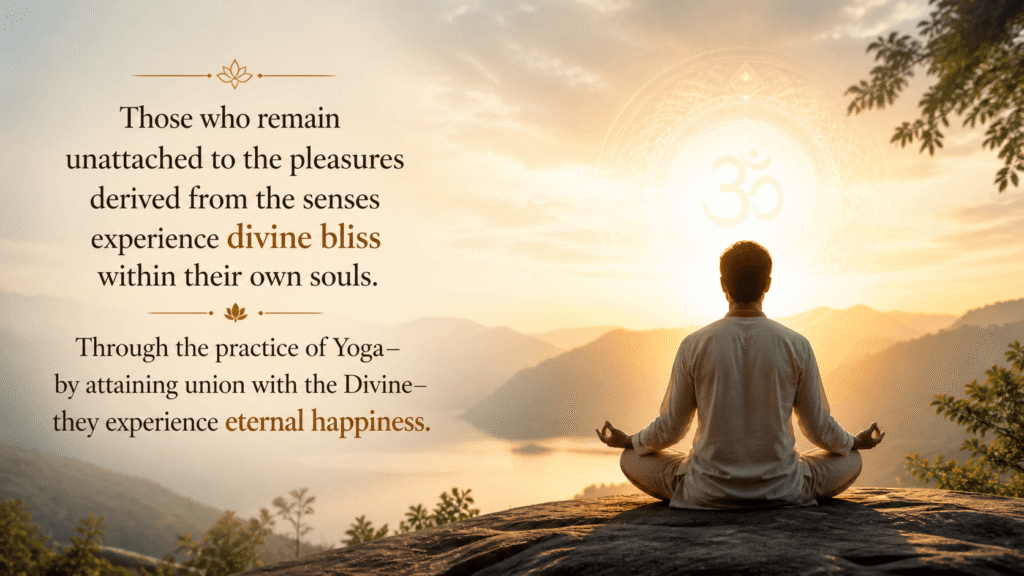
The meaning of this verse is as follows: Those who remain unattached to the pleasures derived from the senses experience divine bliss within their own souls. Through the practice of Yoga- by attaining union with the Divine- they experience eternal happiness.
What Makes Us Happy in Today’s World
What constitutes the basis of our experience of happiness today? We derive happiness from eating our favorite dishes. But can this happiness truly be enduring, or does it last only for as long as we are eating? Moreover, these things are often detrimental to our health, frequently bestowing upon us a host of ailments free of charge. Ultimately, the fleeting pleasure derived from our taste buds can become the root cause of our long-term suffering.
The prevalence of lifestyle-related diseases- for which poor dietary habits are primarily responsible- has consistently remained high. So, does the pleasure of good taste truly yield genuine happiness, or does it merely pave the way for enduring misery? You can answer this based on your own experience.
Similarly, there is a distinct gratification to be found in beholding beautiful things. Whatever we observe serves, in a sense, as sustenance for our mind. If the mind is fed “toxic food” through the eyes- that is, if we gaze upon things that are inappropriate, futile, or toxic- it has a direct and adverse impact. Furthermore, a common consequence of engaging with such negative content is the recurring urge to view those scenes repeatedly; this contaminates the mind, thereby leading to unhappiness. In the pursuit of true happiness, the significance of this principle is paramount.
Consequences of Finding Happiness through the Senses
Many people spend their time listening to and recounting matters that are trivial, futile, and utterly unproductive. When we engage in such behavior, we squander our precious time, physical vitality, and mental energy merely for the sake of the fleeting gratification derived from listening to idle chatter. In pursuit of this momentary pleasure, we jeopardize our long-term happiness- for time is the greatest wealth of all. And to squander one’s wealth is, effectively, to squander one’s happiness.
A similar outcome ensues from the craving for pleasure through the other senses. In essence, this leads to the rapid depletion and wastage of one’s physical vitality, mental energy, wealth, relationships, and- most significantly- the invaluable treasure that is human life itself. Above all, it erodes our inner strengths and drives us miles away from true success. And at that time, even after undertanding the value of happiness and importance of happiness, we find ourselves away from happiness. In order to attain true happiness, we need to follow some principles of happiness, that are timeless and well established.
Actually What Should Make Us Happy
Therefore, it is imperative that we refrain from indulging in any form of sensual gratification and perform our actions with a spirit of detachment. This attitude of detachment plays a pivotal role in bringing us closer to our true selves. And with this core concept, we actually start to understand the relevance of principles of happiness.
The very peace, love, happiness, and bliss that we seek in the external world can be experienced with great ease simply by turning inward and connecting with our inner being. This self-realization can become the true capital of our lives. Through this realization, we can attain oneness with the Supreme Reality- the Divine- and within this union, experience supreme bliss and a happiness that is both authentic and imperishable. This union of the individual soul with the Supreme Soul constitutes true Yoga.
The happiness derived from this union is transcendental- lying far beyond the realm of sensual pleasures. Once this profound happiness has been experienced, the fleeting and fragile pleasures derived from the senses appear utterly trivial in comparison.
Out of the 8 principles of happiness, this is the first one and the most important one. One must start imbibing it slowly and steadily. In the next article, I will elaborate on how to start imbibing it easily. Indeed, it is going to be a wonderful experiment and experience.
Points to Ponder
- Do you agree that in order to always remain happy, you need to follow some principles of happiness?
- Do you agree with this first principle of happiness out of 8 principles of happiness?
- If yes, then please check your daily patterns and find out where does your mind wander the most and why?
- Have you ever tried to control your wandering mind and did you get success in controlling it?
- Who is controlling your mind- you or your sense organs?
- Do you recognise that you’re a unique entity, separate from your mind and body?
- If you recognise it, then could you identify that unique entity- who is none other than you!